Archaeological field technicians should be able to identify pre-Columbian ceramic artifacts in the field. In most places, these are not as common as lithics, but they are still common. Like lithics, they do not decompose, meaning that lithics and ceramics are often the only surviving pre-Columbian artifacts that you might find at a site.
Unfortunately, I have found that many field techs—if not the majority of them—are not able to recognize pre-Columbian ceramics in the field. On more than one occasion, a newly hired field tech has shown me a flat piece of rock, mistakenly believing it to be a sherd of pottery, while other field techs have completely overlooked the real potsherds in their shovel tests or test units. This is understandable, to an extent. Ceramic artifacts are made of fired clay, and clay is simply earth, so ceramic artifacts are often difficult to distinguish from the earth all around them. But if you are not able to recognize ceramics when you see them in the field, you might miss a site in your survey area. Even if you identify a site by the lithics that are visible, but miss all the ceramics, that is still a problem, because ceramics are an important component of any site where they are present. All pre-Columbian ceramics are diagnostic, meaning that they are very informative, and the presence of ceramics might help to elevate a site to eligibility status on the National Register of Historic Places (NRHP).
The sad truth is that the photographs in this blog post will not be sufficient to teach you how to recognize ceramics in the field. The best way to learn how to recognize ceramics is to handle them in person, by working at a lab where ceramics are analyzed or curated, or by participating in a field school or other excavation where copious amounts of ceramics are found. But this blog post may be a good starting point for new field techs or aspiring archaeologists who have never seen pre-Columbian pottery.
Pottery
Ceramics are simply artifacts made from fired clay. Many field techs use the word “ceramic” interchangeably with “pottery,” because potsherds are the most commonly found ceramic artifact. “Pottery” refers to a wide variety of vessels made from fired clay, having a range of different shapes and sizes, including pots, bowls, jars, beakers, and bottles. Potsherds found in the field are often so badly broken that you cannot determine the form of the original vessel. Pottery is not the only kind of pre-Columbian ceramic artifact, but I will discuss the others later.
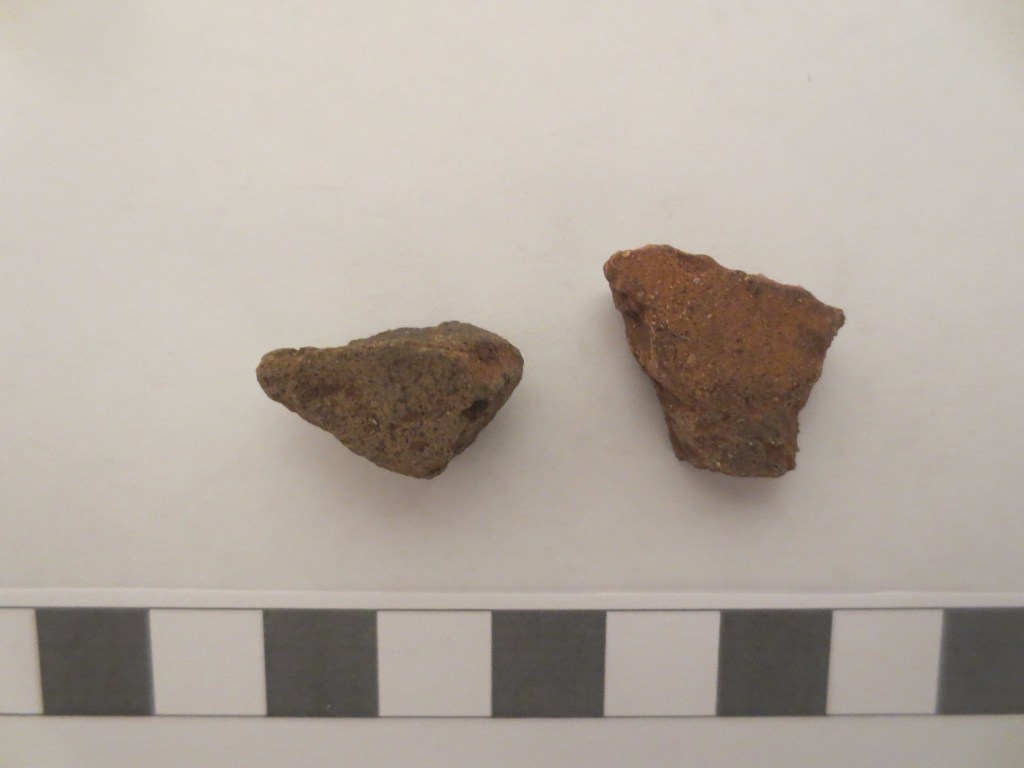
It’s worth noting that not all pre-Columbian vessels were made from fired clay. Ancient Native Americans wove baskets out of plant stalks, or used hollow gourds as vessels. These organic remains have not survived in most places. Ancient Native Americans also carved bowls out of steatite (soapstone) or sandstone. These bowls would be considered lithic artifacts.
Pre-Columbian pottery was made from a clay paste mixed with tiny pieces of an “aplastic” tempering agent. “Aplastic” simply means that the pieces of temper are not easily shaped or molded. Tempering agents included sand, moss, grog (small pieces of previously fired pottery), grit (crushed stone), bone, and mollusk shell. Native American potters added these tempers to their clay paste to prevent the clay vessel from shrinking too rapidly while being fired, because rapid shrinking would lead to cracking. These potters generally did not have access to kilns that could allow them to precisely control the temperature at which a vessel was fired; in fact, they would often simply place a clay vessel above an open fire and wait for it to harden. This method of firing made it necessary to add temper to the clay.
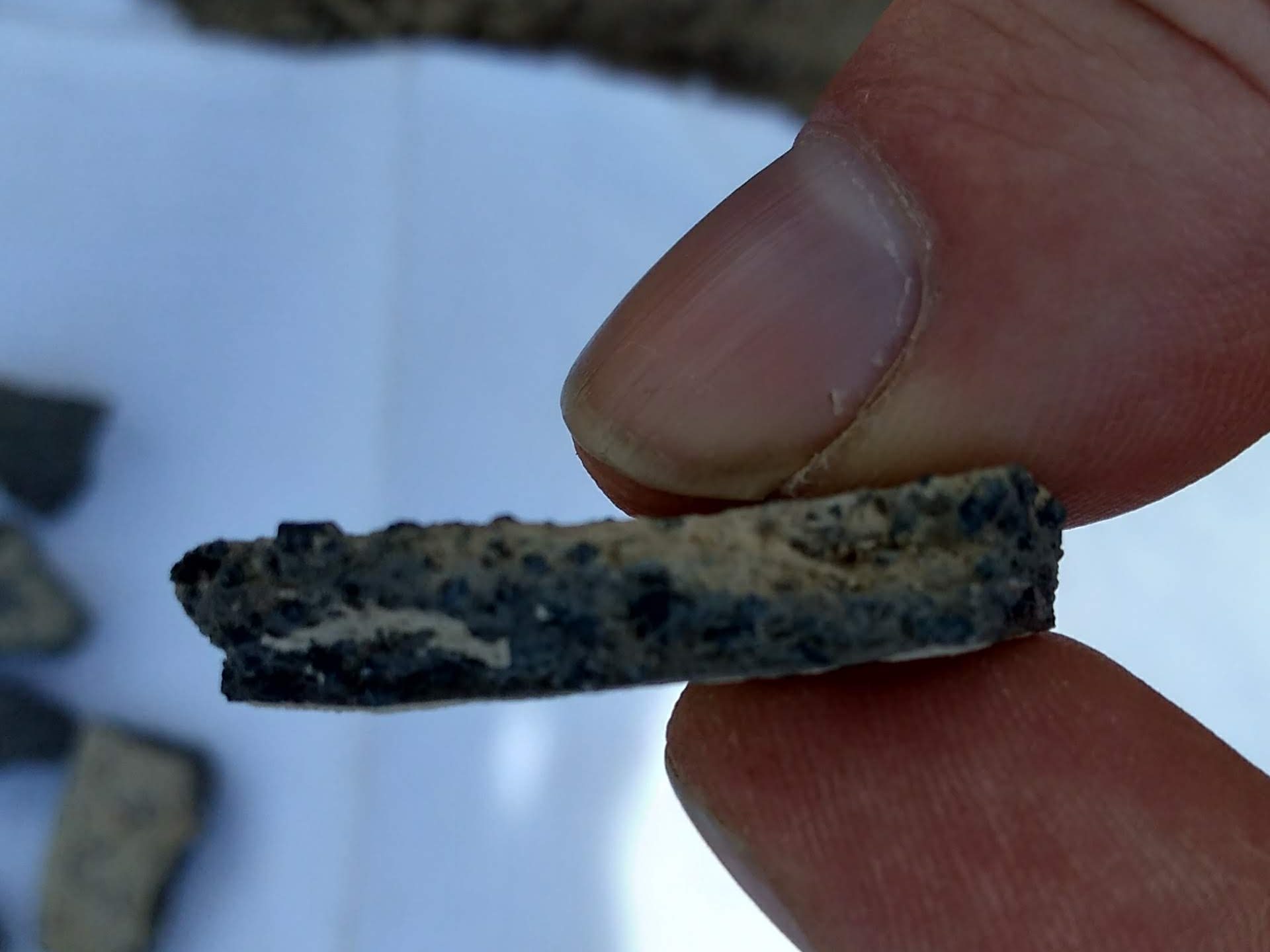
Pre-Columbian potters often made vessels by a method known as coiling. They would roll pieces of their clay paste (mixed with temper) into long rope-like segments, and stack these “ropes” together in a coil to form a pot in the desired shape. Then, the surface of the vessel would usually be smoothed over, removing any visible trace of the coils. Some potters left the coils visible; we call this “corrugated” pottery.
Not all pottery was made by coiling. Another technique was to use a paddle to shape clay into the form of a vessel around an anvil stone. The paddle would typically be wrapped with cordage to prevent it from sticking to the clay. The cordage would leave impressions in the outer surface of the vessel; this is known as “cord-marked” pottery. A paddle might also be wrapped with a net or some kind of fabric, resulting in “net-impressed” or “fabric-impressed” pottery.
Some small vessels were probably not made by either method. For example, the small “paint cups” found on the Southern Plains were probably shaped from a single piece of clay with the potter’s fingers.
Unlike later pottery of the historic period, pre-Columbian pottery found in the United States is almost always unglazed (though some Southwestern potters of the late prehistoric period managed to make glazed pottery). However, there were other surface treatments available to the Indigenous population. Some potters would “burnish” the exterior of their vessels by rubbing it smooth with a piece of stone. Some potters would also apply a “slip,” or clay slurry, to the surface of a vessel before it was fired. The slip would give the surface of the vessel a different color. For example, Mississippian potters often used a red slip, Caddo potters often used red and black slips, and Southwestern potters often used a white slip. Before firing, the potter might also apply paint over the slip. Paints and slips are not always preserved, as they tend to be eroded by the elements.
All pottery is considered diagnostic. Pottery was not used for most of the human history of North America, so the mere presence of pottery at a site allows you to narrow down the date range considerably. For example, in the Eastern Woodlands, virtually all pottery dates after 1000 BCE. Furthermore, many ceramic vessels have decorations that can be attributed to a specific time and culture. Decorations might include stamps, incisions, punctates, or dowel marks in the clay, as well as any slips or paints applied over the clay paste.
Even undecorated pottery can be dated by its temper, because Indigenous potters used different tempering agents at different times in history. These chronologies are regionally specific.
For example, in what is now Illinois and Missouri, pre-Columbian potters used grit temper for much of the Woodland period, before switching to limestone temper around roughly 700 CE. Limestone temper had been used sporadically—though not heavily—throughout the Woodland period, but it did not become the predominant temper until 700 CE, in the Late Woodland period (though limestone temper was heavily used at some Hopewell sites in western Illinois at a much earlier date). Potters began using shell temper during the Emergent Mississippian period around 800 CE, and by 900 CE, shell temper was ubiquitous at many Mississippian sites in Illinois and Missouri. Shell temper would remain the predominant temper throughout the remainder of the Mississippian period. Even within this specific region of the middle Mississippi River Valley, there are many local exceptions, so for more information, see Hoard, O’Brien, Khorasgany, and Gopalaratnam (1995).
Meanwhile, farther south along the Mississippi River, in Louisiana, the earliest pottery was tempered with fibers from palmetto leaves and Spanish moss, rather than grit. These plant fiber tempers were not used in Illinois or Missouri, because palmettos and Spanish moss do not grow that far north. Plant fiber tempers were eventually replaced by grog temper, and then by shell temper during the Mississippian period.
And farther west, on the Great Plains, the Plains Villagers generally did not use shell temper until about 1300 CE, if they used it at all.
It is beyond the scope of this blog to describe the decorations of every type of pottery found in the United States, or outline the chronology of pottery types in every region. Such an endeavor would take a lifetime. The goal of this blog post is merely to help field techs become familiar with pottery in general.
Below are some pictures of different kinds of pre-Columbian pottery found in different regions of the United States.

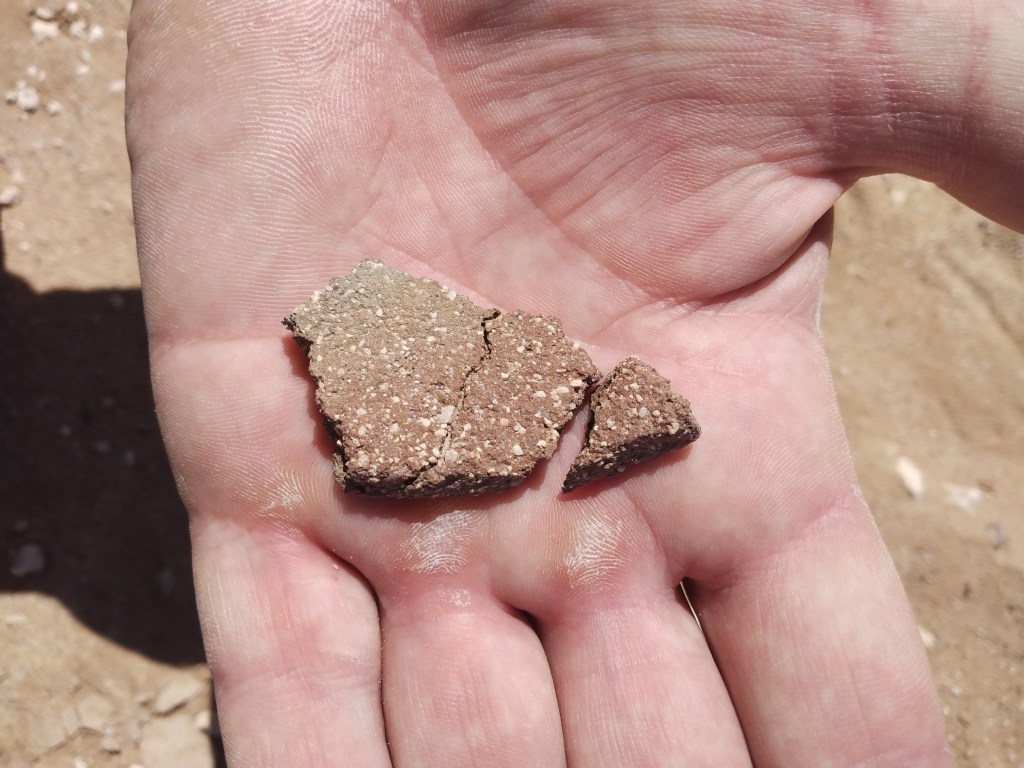


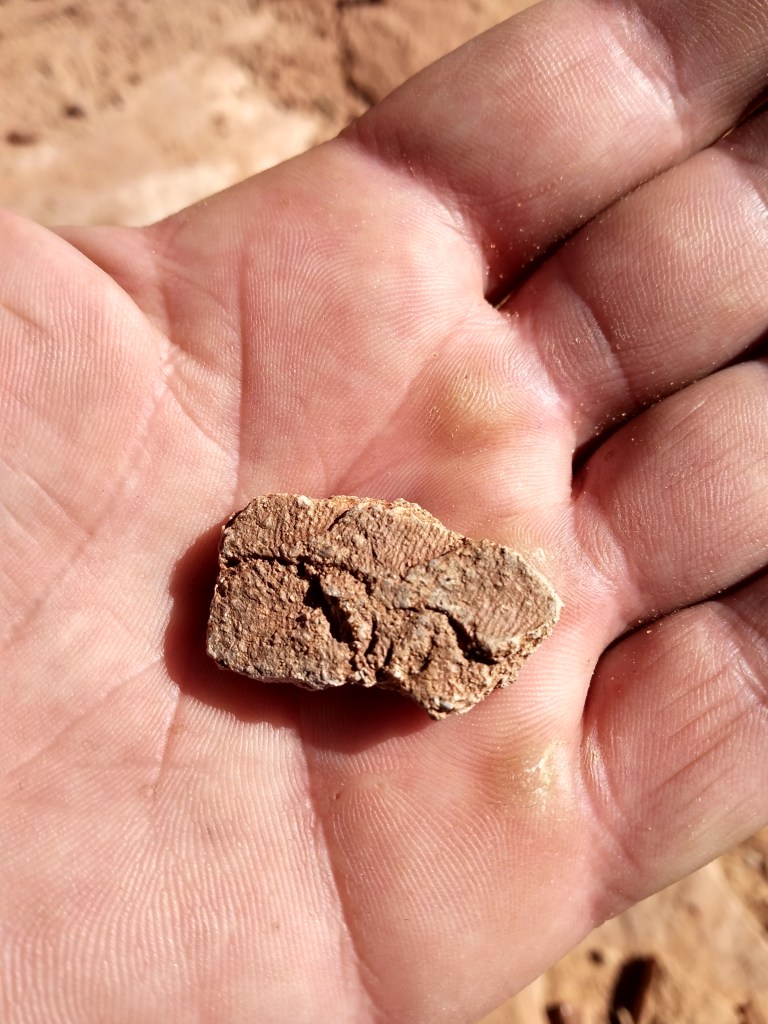

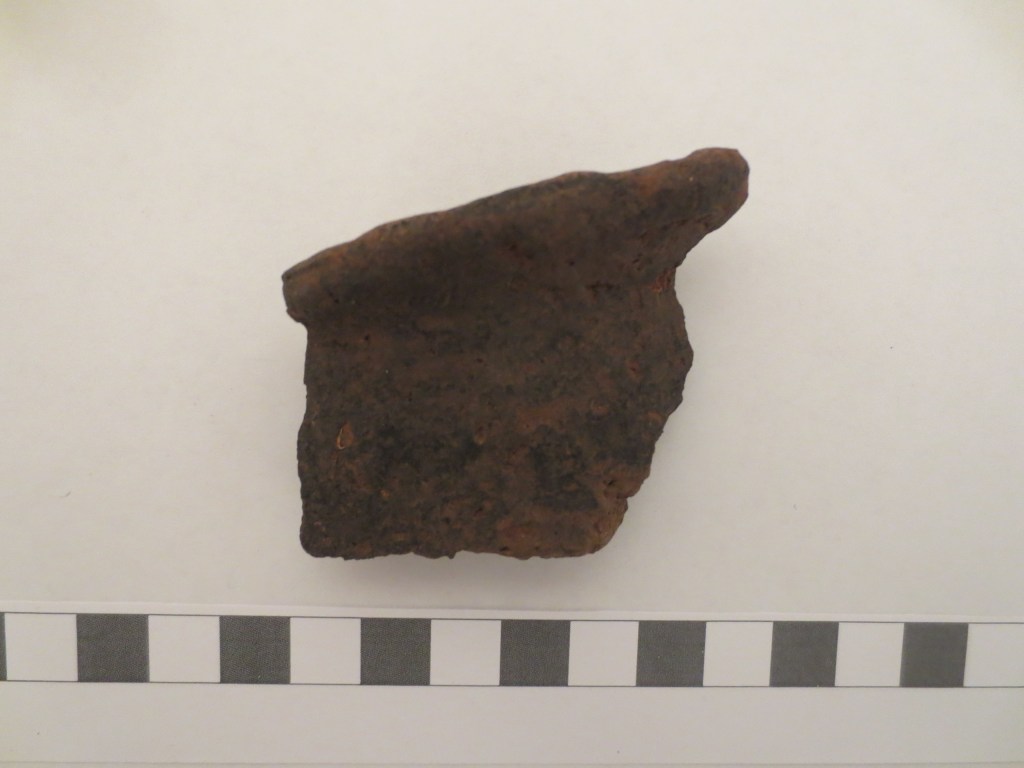
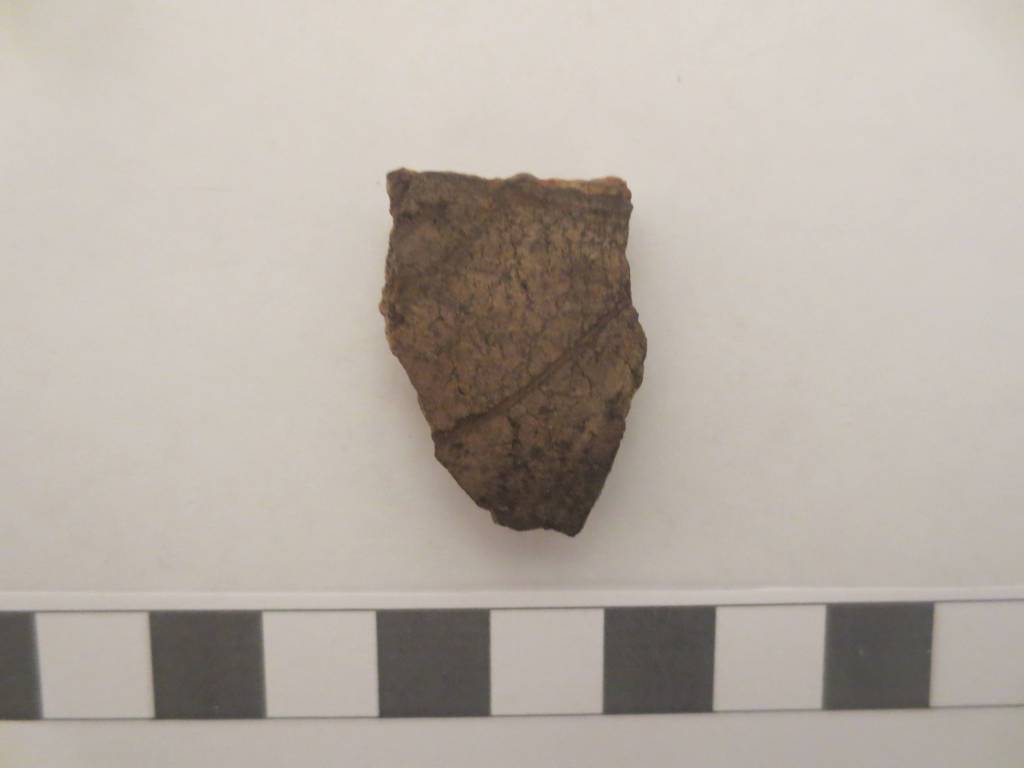
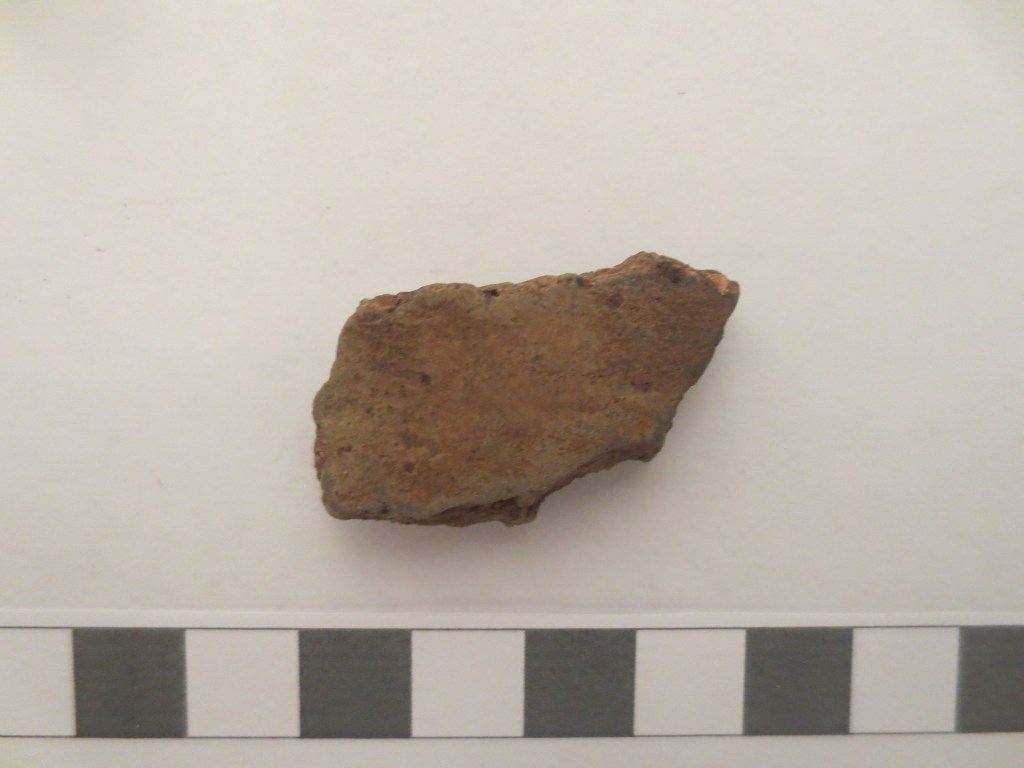
As can be seen in the photographs above, pottery in the United States is extremely variable. Field techs should become familiar with the types of pottery found in the regions in which they work. One common theme, however, is that pottery is often difficult to distinguish from the surrounding soil, and from the naturally occurring rocks in the soil. Which makes it difficult for field techs to notice pottery when they see it. Many field techs mistakenly identify rocks or pieces of modern brick as pottery, while failing to notice the real potsherds in their shovel tests. Even after handling hundreds of sherds of pottery myself, sometimes I still find it difficult to distinguish real potsherds from naturally occurring rocks, or other clay artifacts such as burned daub.
Other Ceramics
Pottery is not the only kind of pre-Columbian ceramic. Native Americans also fashioned smoking pipes, pottery trowels, and earspools out of clay before firing it.
Pottery trowels are mushroom-shaped tools, often made from fired clay, used to smooth out the interior surfaces of clay pots. Smoking pipes are hollow, cylindrical artifacts used for smoking plants such as tobacco, often in a ceremonial context. To complicate matters, not all pipes are made from clay. Some were carved from soft stone, such as catlinite, and thus they would technically be lithics. Earspools are round pieces of jewelry, often made from fired clay (and sometimes coated with copper), which were placed within a person’s pierced earlobe (very similar to the ear gauges worn by modern people).
On the Gulf Coast, Native Americans used fired clayballs for cooking. Throughout most of North America, Native Americans cooked food over hot stones. But on the Gulf Coast of Texas and Louisiana, due to the lack of naturally occurring stone, the Native Americans rolled up balls of clay and cooked over those instead.
On at least one occasion, while visiting a field school at the Morton Village site in Illinois, I have seen a beaver tooth fitted with a ceramic handle. The tooth was used as a scraper, and it was attached to a ceramic handle to make it easier to use. I have never seen another artifact like that, either in person or in the reports I’ve read, but I assume there must be others.
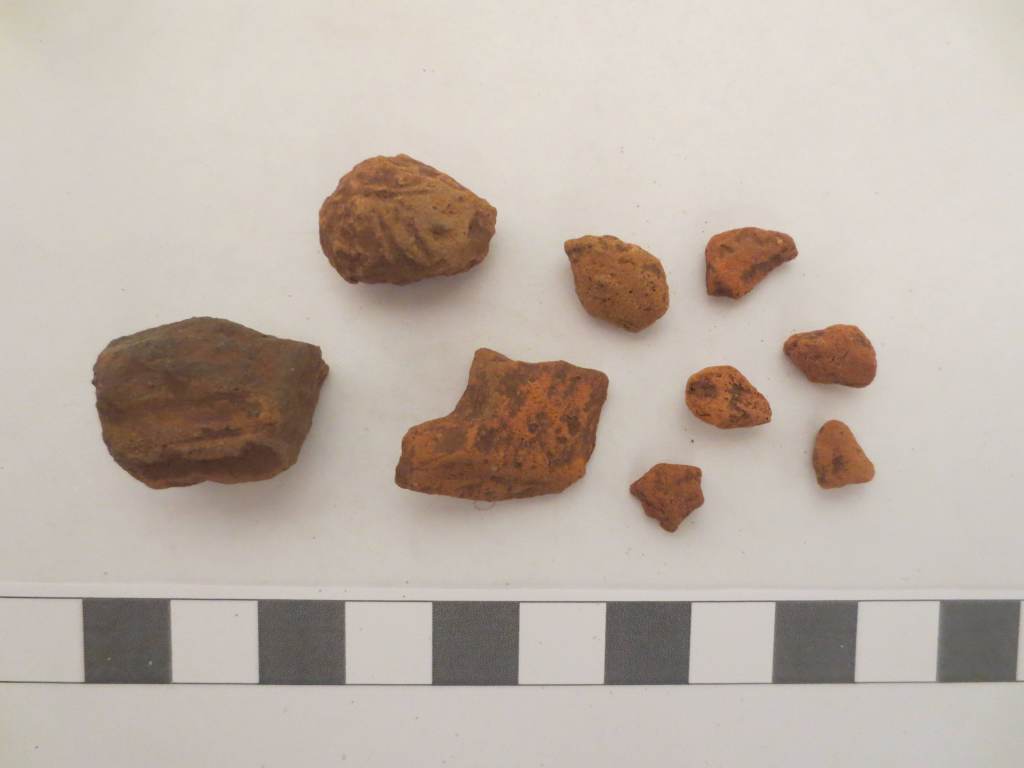
Many Native Americans plastered the walls of their houses with clay, known in this context as “daub.” Daub was used in a construction method known as “wattle-and-daub” building. The walls would be made of sticks woven with thin twigs or plant stalks, and these would be covered in a layer of clay. Often, these houses would be burned down after a certain period of time. As the daub was exposed to the fire, it would take on the properties of any other fired clay. I don’t think all archaeologists would refer to burned daub as a “ceramic” because it was not intended to be used after its exposure to fire, but burned daub from a house fire does have the same properties as a “ceramic” artifact.
These pieces of daub can still be found, centuries later, and they often designate the location of a house. Sometimes, you can see the imprints from the twigs or plant stalks (wattle) against which the clay was pressed when the walls were first built.
Sources
Butts, Bruce. 2013 Tempering in Southern Pottery. Central States Archaeological Societies. Electronic document, https://csasi.org/2013_july_journal/tempering_in_southern_pottery.htm.
Canadian Museum of History. 2024 Pottery Making Techniques. Electronic document, https://www.historymuseum.ca/cmc/exhibitions/archeo/ceramiq/cerart5e.html.
Carmichael, Patrick H. 1998 Nasca Pottery Construction. Electronic document, https://digitalassets.lib.berkeley.edu/anthpubs/ucb/text/nap024-003.pdf.
Florida Museum. 2024. Common Inclusions and/or Tempers. Electronic document, https://www.floridamuseum.ufl.edu/ceramiclab/galleries/common/.
Hoard, Robert J., Michael J. O’Brien, Mohammad Ghazavy Khorasgany, and Vellore S. Gopalaratnam. 1995 A Materials-science Approach to Understanding Limestone-tempered Pottery from the Midwestern United States. Journal of Archaeological Science 22:823-832.
Museum of Fine Arts, Houston. 2024 Hopi Pottery Display.
Office of the Wyoming State Archaeologist. 2024 Fremont Ceramic Tradition. Electronic document, https://wyoarchaeo.wyo.gov/index.php/wyoming-archaeology/aspects-of-wyoming-archaeology/wyoming-pottery/wyoming-pottery-project/fremont-ceramic-tradition.
Perttula, Timothy K., Myles Miller, Robert A. Ricklis, and Daniel J. Prikryl. 1995 Prehistoric and Historic Aboriginal Ceramics in Texas. Bulletin of the Texas Archeological Society 66.
Texas Beyond History. 2001 Firecracker Pueblo-Pottery and Pottery Making. Electronic document, https://www.texasbeyondhistory.net/firecracker/pottery.html.
 Broken Shovels Emporium 2.0
Leave a comment